
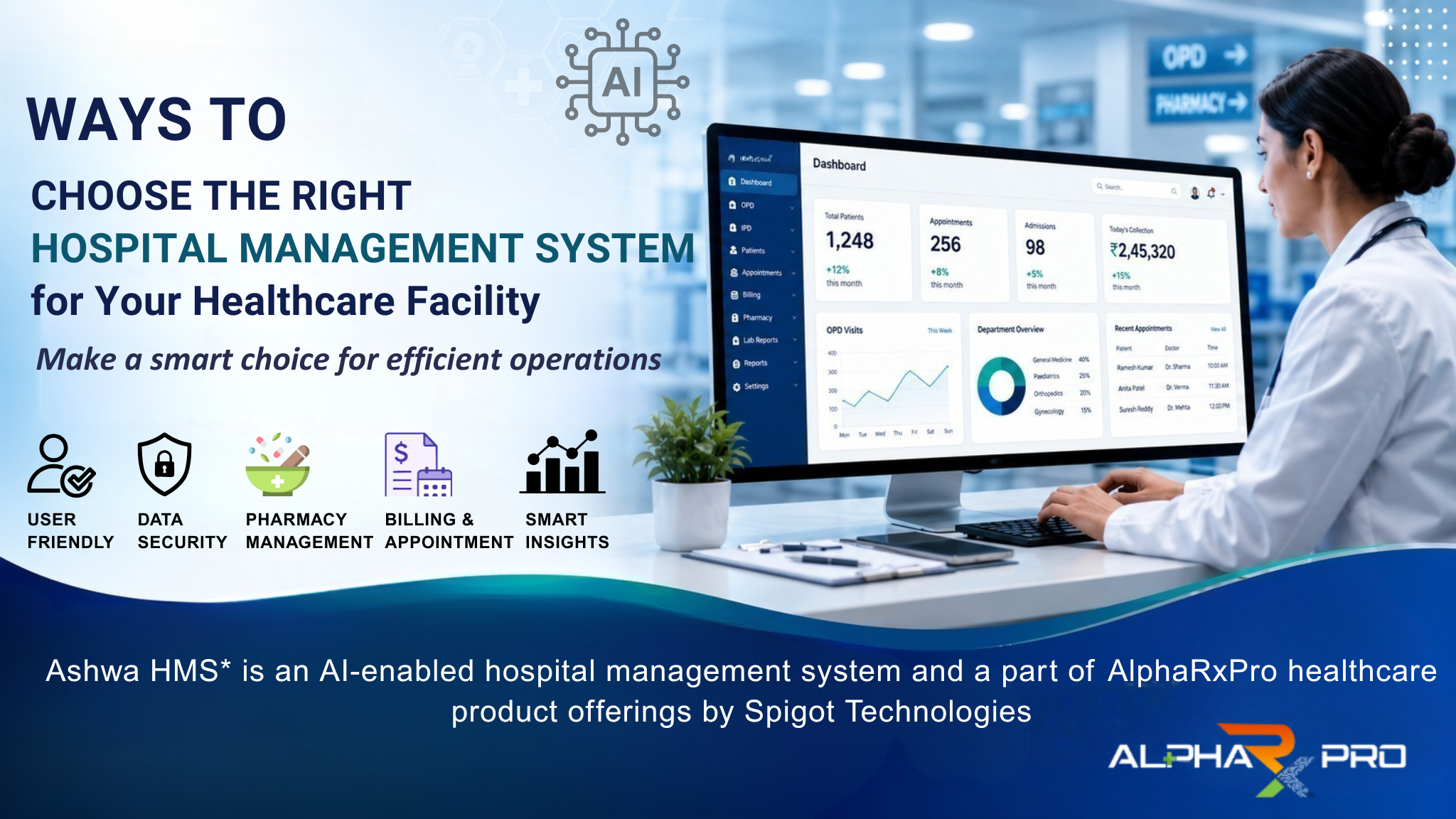
A lot has been discussed and emphasised about the imperativeness of a Hospital Management System (HMS) in healthcare facilities. It is an undeniable fact that an HMS helps mitigate risks and handle unwieldy procedures in the very ecosystem. Now the quintessential question arises about the right ways of choosing one. Given the present scenario, where we have a plethora of vendors and options available both in the offline and online marketplaces, it can be increasingly overwhelming to decide on a reliable, scalable and secure HMS for your set up.
There are many things that you can scrutinize to arrive at a decision, which can positively impact the ROI of your facility and take you a long way with many other intangible benefits. You must importantly take into account the specific requirements of your hospital, nursing home, diagnostic centre, clinic or pharmacy to make the right choice. We have listed some important aspects that you must check or consider before deciding one.
Choose an Easy-to-Use Hospital Management System
An HMS that is easy to use and straightforward can help you make life easier in your facility. The onboarding process becomes simpler, if there an intuitive UI implicit in the software. The user friendliness aspect of the software depends on how well the software can reflect the information seamlessly and instantaneously across all the departments. The number of fields in the very process, and ease with which an individual can comprehend or learn the software can impact the user friendliness of the software.
Request a Live Demo Before Choosing an HMS
We are living in a world where the viability or truth of whatever is marketed is constantly questioned. In such a scenario, where vendors make tall and unrealistic claims about the software, it would be wise to watch the demo of the software. During the demo, you get a glimpse of the software’s internal view and UI.
Check Data Security and Compliance Features
This is something that hospitals and nursing homes overlook while choosing an HMS. Data security is extremely crucial as any potential loss of data, or lapses that arise due to absence of proper encryption, access controls and audit trails, can be extremely detrimental for the hospital.
Evaluate Pharmacy Management Features
The pharmacy an integral part of any hospital and plays a pivotal role in the dispensing of drugs to patients. It unabatedly contributes to the revenue of the hospital. A software system that handles the pharmacy must peremptorily handle batch tracking, expiry alerts, reorder level management, and the connect between the ward and the pharmacy. It is particularly useful to prevent filching in the pharmacy.
Look for Smart Billing and Appointment Management
In this stressful and busy environment, it is difficult to remain fastidious and meticulous, while billing patients. It is quite possible to miss out on an entity, or end up adding multiple entities inadvertently. All these can be prevented by making use of a Hospital Management System. You must also look for dashboards that can help users make informed decisions, and the implicit feature to automate discount calculations.
Essential Features Every Hospital Management System Should Have
It is the onus of the healthcare facility or hospital to pave the way for smooth and streamlined operations. It is a must for you to check the modules pertaining to patient registration, profile management, appointment booking and reminders, doctor scheduling, billing generation, lab report management, pharmacy management, role based access control and reporting.
Get Smart!
It is advisable for hospitals and doctors to avoid a clunky software. An HMS with an intuitive UI can serve as an elixir for all the administrative problems in a hospital. Predefined templates and IPD notes are noteworthy features that would certainly make a difference.
Compare Pricing and Customization Options
While the pricing of the software is seen as the prime or the most important factor in deciding one, there are many who end up taking a murky decision as there is no “one size fits all strategy”. It would be prudent for any hospital to ask for a personalised quotation from the vendor and must evaluate the same based on bed capacity, number of users, modules required, level of customisation involved, kind of customer support offered and the timeline for implementation.
Common Mistakes to Avoid When Choosing a Hospital Management System
A well planned approach can certainly help you make the right decision in a scenario where the options are numerous and the market is volatile. Ensure that you map the features of the HMS with your existing workflows and distinctive needs. A comprehensive training program must go hand in hand to avoid confusion and maximise productivity. So, choose a brand that imparts the right kind of training and offers reliable customer support.
Additionally, you must verify if the HMS adheres to all the requisite security and privacy standards. From the scalability standpoint, you must choose an HMS that can be easily customised and allows future upgrades.
Here are few frequently asked questions that could help you melt the iceberg and choose the right Hospital Management Software.
Conclusion
The decision to implement a Hospital Management Software (HMS) is certainly a matter of perennial importance, as it portentously shapes the way your hospital would operate in years to come. Ashwa Dazzle, a part of AlphaRxPro’s healthcare product offerings by Spigot Technologies can support every aspect of your workflow thereby improving your accuracy and operational performance. This AI Hospital Management System also offers features that can automate numerous daily tasks that include scheduling, cancelling, and rescheduling of appointments, improving bed utilisation, providing documentation support, and a lot more!
1. What are the delivery models available in an HMS?
A. Usually, an HMS is available in both On-premise and Cloud Modes. While an On premise entails a prerequisite set up of servers, IT infrastructure and annual maintenance costs, a Cloud deployment can be done without local servers but does require a robust internet connection.
2. Are there any concealed costs while purchasing an HMS?
A. We would like to reiterate that it is always wise to ask for a personalised quotation from the vendor. The situation usually encountered is that low prices are communicated initially to the hospitals or decision makers, and then additional charges for implementation, data migration or extra modules are brought into picture at a later stage. It is a must to know the complete landscape before taking a decision.
3. What is the time duration needed for HMS implementation generally?
A. It is important to understand that implementation timelines may differ based the size of the hospital, complexity and the specific requirements of the hospital. You must ask for a plan especially in scenarios where training and data migration are inherent.
4. What are the some of red flags that you must be cautious about, while choosing your HMS?
A. We have listed some red flags that could help you make the right decision about your HMS. There are scenarios, where the vendor says they cannot show a demo of the software. In some cases, you may find an obsolete UI in the software. Additionally, if the software has an extremely low price, it could possibly lack some of the essential features. It is advisable to avoid buying the software from such vendors.