
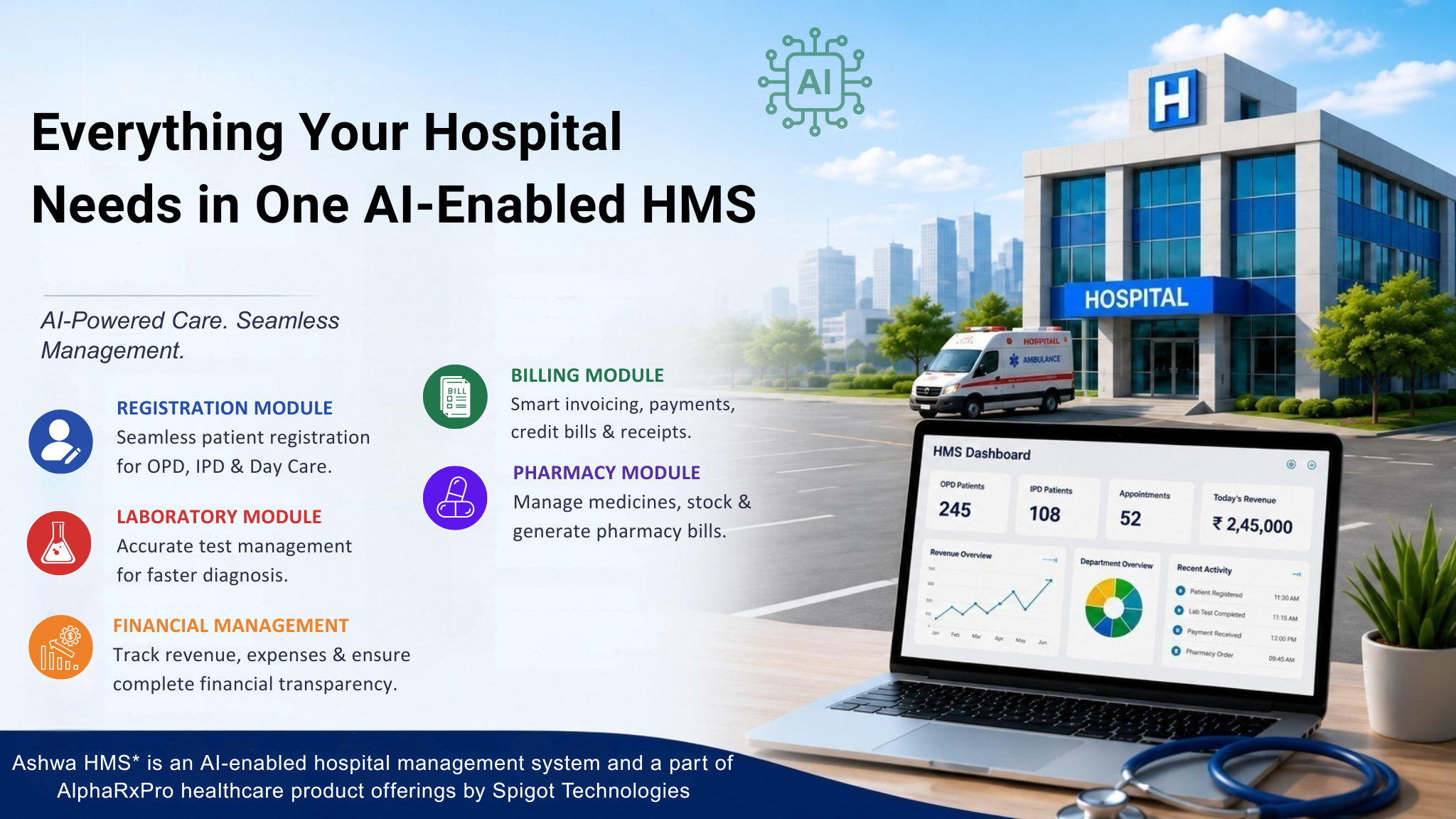
A Hospital Information Management System is essentially a comprehensive software that includes all the necessary modules and features. Many hospitals today need a complete overhaul as several traditional methods such as manual registers and spreadsheets have become obsolete and can no longer be banked upon. The increase in expectations from patients and pressure to comply with strict regulatory requirements have created an extremely pressing need for authentic data to be available for both the staff and the patients.
What is a Hospital Information Management System?
To be clear, it is an all encompassing software that can help you simplify your hospital operations while taking your administrative efficiency to a new high.
So, there are modules in an HMS that are distinct functional units and they all put together form the complete Hospital Management Software. With several activities going hand in hand such as managing patient records, tracking and managing appointments, maintaining staff records and managing insurance claims, it is an onerous responsibility on the hospital to manage these activities correctly while minimising operational expenses and improving patient experience. All these can be easily accomplished using an HMS.
Let us see the most essential modules of any Hospital Management System.
Patient Registration Management
A registration is the foremost thing that is done for any patient. Without a digitised registration, it is difficult to keep track of patients’ details or history. It can also impact the patient’s experience in the hospital. The process of registration creates a unique UHID that is used by patients until they stay in the hospital. Registration is done distinctively for OPD, IPD and Day Care patients. A bar code sticker is generated in the very process.
Smart Billing & Invoicing
The billing module is one of the most crucial modules in the HMS. This particular module allows the hospital to stay updated on the payments and invoicing. It enables the users to also make use of the prevailing government aided schemes and insurance schemes provided by banks to complete the payments. Apart from these, there are numerous useful features that include offering refunds in different scenarios, and generating receipts and provisional bills.
Laboratory Information Management
This module ensures the smooth functioning of tests and minimises diagnostic delays. Inherently this module is used to advise test requests, collect samples, and provide the observed values against preset reference ranges. As it takes diagnostic accuracy to a new high, it decreases the turnaround time of the patient and this in turn enables the hospital to treat more patients positively impacting the ROI.
Pharmacy Management
This module is responsible for the efficient management of pharmaceutical drugs in a hospital. It is also one of the prominent sources of revenue for the hospital. There are several valuable features in this module. For instance, it empowers doctors to advise drugs that are available and keeps the pharmacists informed about the drugs that are out of stock. It offers specific benefits for pharmacy distributors, hospitals, and retail pharmacies. You can either generate an independent pharmacy bill, or add the pharmacy bill to the consolidated hospital bill.
Financial Management & Accounting
There are several transactions that happen in a hospital that invariably include billing, and payments. So, revenue accounting and expenditure management are the lifelines of any hospital. All these can be tracked effectively using this module. It can be seamlessly integrated with OPD, IPD, Pharmacy and Lab to ensure an unequivocal transparency in the financial operations.
Laundry Management
It is extremely important in a hospital to manage the personal hygiene and cleanliness of an individual. They are very imperative in scenarios where the patient is convalescing or recovering from any kind of casualty. While the arduous task of keeping track of laundry involves tremendous meticulousness, it can become very unwieldy for a hospital. The laundry management module is useful as it gives info to prepare the patient’s room, clean of windows, change linen and help maintain the requisite stock.
In addition to all these, you can ensure timely circulation of clean linen and patient uniforms. It is certainly a value add for any hospital especially with its intrinsic time management feature.
Doctor Management System
This is indeed one of the smartest modules we have in any Hospital Management Software. Doctors can prescribe medications, and advise lab tests, radiology tests, or even pharmacy drugs from this very module. Doctor can refer patients to other doctors or hospitals, and many smart modules also enable doctors to create a referral letter report.
Blood Bank Management
Blood banks are an indispensable part of any hospital. They carry out the onerous task of collecting blood samples from the donors and donating blood to the patient who is in need of it. Blood banks are viewed as life saving entities which make the desired blood group accessible to the patient in the direst of times.
A blood bank must undertake extremely cautious and synchronising steps throughout, as it deals with the lives of patients. The entire process involves cross matching, antibody screening, and managing paper records. This helps keep track of information pertaining to blood storage, patients, doctors, inventory management, billing, reports and other utilities. All these can take a toll on the entire system and very well be simplified by using a blood bank.
Nursing Station Management
This module serves as the command centre while exercising care for patients. Nurses are entitled to advise tests, allocate wards and collect lab samples. In addition to these, they can schedule appointments for doctors and handle booking of OTs.
Overall, the nursing module helps nurses with doctor order execution and monitoring. It also helps them with incident reporting.
AI-Powered Hospital Management System
In the present scenario, it is impossible to ignore the advent of AI and the tremendous performance possibilities that it can offer a hospital. Some of the notable uses are its ability to schedule, reschedule and cancel appointments, and the AI voice scribe feature that converts voice to text. The data driven approach ingrained provides valuable insights to make informed decisions and identify areas of improvement.
Spigot’s AI powered hospital information management system has immense potential in transforming the hospital sector with its distinctive features and scalable solutions. Call us today to learn how you can do wonders by streamlining administrative processes, and reducing operational costs.